10: black and white

Dear Friend,
Back in the early 1960s, Frank’s mom dropped off the family station-wagon to be serviced, it had suddenly started acting weird. The mechanic soon discovered the problem and the car was good as new after twenty-one plastic circus animals were rescued from the gas-tank.
(Frank shared that story with me yesterday following his long day of repairing rodent damage to our vehicle).
It’s hard to believe that our fix-it-guy is the same person that, at 3-years of age, had unscrewed a gas-cap and, one by one, had disappeared his whole collection of Ringling Brothers Barnum and Bailey’s.
Are you reminded of doing something similar? As a child, were you often (or seldom) left to your own devices? It’s funny how, now that we’re grownups, we find ourselves saying, ‘I can’t believe my parents let me do that!’
When little kids have a chance to navigate the big world, they are likely to operate without much hindsight, consequential reasoning, what will happen if-s… that stuff is gobbledygook.
What matters is this moment, a handful of toys, and a hole in the side of a station-wagon.
Just as you are uniquely you, and I am uniquely me, Frank is uniquely him. There are times when Frank’s whole day is about how he can best photograph what he is seeing.
He waits patiently for the right light and maintains his photography / videography work tools, calibrating so that colors and densities are as accurate as possible. This accuracy matters to him very much.
But what if a person is colorblind? What do they see? In order to demonstrate (vs just writing about it) I found a YouTube Video that gives examples of What Colorblindness Looks Like. (Link follows this blog/letter). In order to see color, the rods and cones in the retina of our eyes are lined up and working 'normally.' There are several types of colorblindness, each attributed to a shift in the functioning of rods and cones. One type, achromatopsia, is extremely rare, very few people actually see the world in black and white.
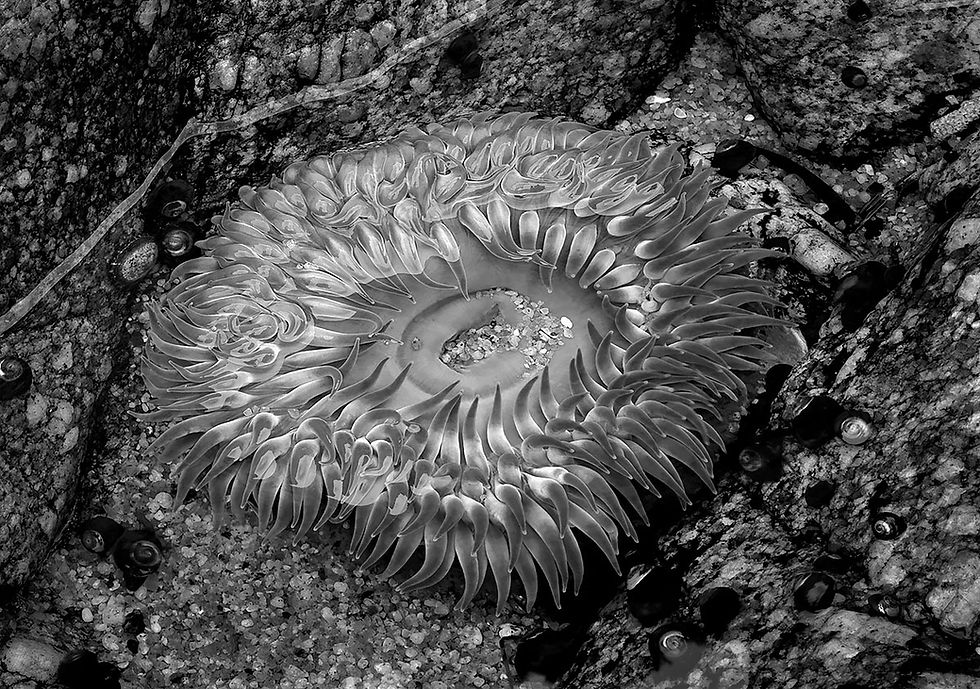
Colors do play a role in our day to day world, they attract, distract, are a way of expressing emotion, but color is just an extra way to convey what eyes are seeing. There is also a wide range of gray values that fall between 100% white and 100% black. Black and white artwork is alive with gray, allowing our eyes to perceive depth and contrast so that we can make out the shapes of things, and these values help us to find the focal point(s) as we experience a photo, drawing, video, or painting.
We hope that you enjoy this collection of Frank’s black and white images:
‘3 days in March’












Thank you for being here.
It means a lot that you take the time to check in with us. When you have a moment, Please Write and let us know how you’re doing. If you would like to tell us about a time when you, too, were a child and things happened … please do! No matter what you write about, we always enjoy hearing from you!
May your week allow you to be in the moment, from moment to moment, and may you discover with childlike curiosity another reason your world is truly a magnificent place!
Gently Be,
Leslie and Frank
PS: Here is the link to the video: What Colorblindness Looks Like
Pps: We are collecting stories and images about Nature to post in a future blog/letter entitled, Nature Shares. If you’d like to participate, just let us know! It's easy to do and, yes, you may remain anonymous.


